
Everyone’s Talking About Rates. Here’s What Buyers Might Be Missing.
If you’ve been following the housing conversation, you’ve probably heard plenty of reasons to wait.
Mortgage rates. Monthly payments. Uncertainty about what comes next.
Those concerns are real. But they don’t tell the whole story of what’s happening when buyers and sellers actually negotiate.
Here in Northeast Georgia, I’ve been helping buyers put together purchases with meaningful price reductions, seller-paid closing costs, and terms that fit their plans.
That doesn’t mean every home is a bargain. It does mean some opportunities deserve a closer look.
If you’re financially prepared and interested in buying, looking doesn’t commit you to anything. We can be selective.
A brand-new Hartwell home, and a firm $350,000 budget
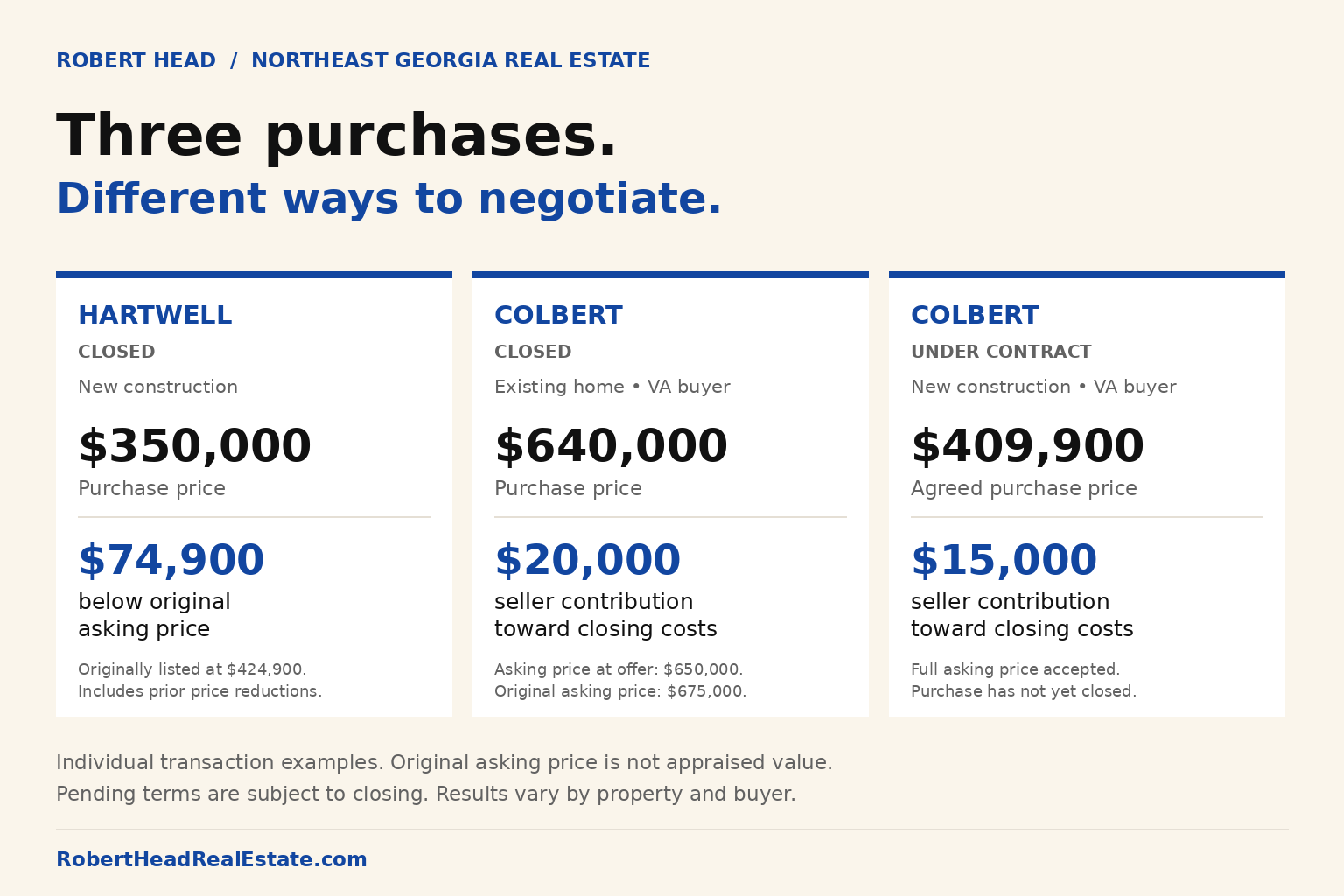
One recent purchase involved a new-construction home near Lake Hartwell.
It originally hit the market in May at $424,900. After several price reductions, the asking price was approximately $375,000 when my clients toured it.
They loved the home. Their position was straightforward:
“If we can get it for $350,000, we’ll take it.”
Instead of pushing them above their budget, we worked on making the rest of the offer attractive.
We offered meaningful earnest money, a reasonable closing timeline before the holidays, and a shorter due-diligence period they were comfortable with.
I explained our approach to the listing agent: the buyers were firm on price, so we had put our best foot forward everywhere else.
Less than 24 hours later, we were under contract.
We still completed an inspection. I coordinated with an inspector we regularly use and got him out within 24 hours.
The buyers closed in November at $350,000—$74,900 below the original asking price.
That full difference wasn’t negotiated in our offer; the builder had already reduced the price substantially. Our negotiation secured roughly another $25,000 reduction from the asking price at the time.
The lesson: a firm budget and a thoughtful offer can work together.
In Colbert, the price was only part of the negotiation
Another client purchased an existing, owner-occupied home in Colbert using VA financing.
The home originally listed for $675,000 and was priced at $650,000 when we negotiated the purchase.
We agreed on:
$640,000 purchase price
$20,000 in seller contributions toward closing costs
The purchase closed on August 28.
For this buyer, the seller contribution was a major part of the outcome. Their out-of-pocket expenses were roughly $1,000, primarily for items such as the inspection and appraisal.
The result was both a lower purchase price and substantially less cash needed to complete the purchase.
That’s why I encourage buyers to look at the complete offer. The purchase price matters, but so does how much money you need upfront.
Full asking price can still come with meaningful concessions
A third purchase, currently under contract in Colbert, shows another approach.
This new-construction home had been on the market for less than 60 days. We offered the full $409,900 asking price, with a request for $15,000 toward closing costs.
The seller accepted.
For this VA buyer, the current expectation is no additional cash due at closing, subject to final lender and closing figures. Separately paid expenses still need to be accounted for.
Someone looking only at the purchase price would miss a significant part of that negotiation.
VA financing and seller-paid costs can work together, but eligibility, allowable costs, and the transaction’s details determine the outcome. These examples aren’t a promise that every buyer can purchase with the same cash requirement. Veterans Affairs
What I tell buyers who aren’t in a rush
You don’t need to buy something just because you start looking.
We can discuss your budget, establish what you want, and explore homes that fit. If nothing makes sense, we keep looking or pause.
But if we find a home you love, we can evaluate the opportunity in front of us:
What do comparable sales suggest about the price?
Is the seller willing to contribute toward closing costs?
What does the inspection reveal?
Can we agree on timing and terms that work for you?
Does the full monthly payment fit comfortably?
These recent purchases have given my clients meaningful room to negotiate. That opportunity varies by property, seller, and price range, which is why the individual home deserves more attention than a broad headline.
The rate matters. So does the rest of the purchase.
I’m not going to tell you to ignore the interest rate. You have to live with the payment.
But the home, purchase price, condition, upfront costs, and contract terms also matter.
Rates can move in either direction. A future refinance may or may not be available or worthwhile, so the purchase needs to work with the financing you have today.
Likewise, buying below asking price doesn’t automatically establish equity. We need to evaluate the property’s value, not simply compare it with what the seller originally wanted.
The goal is a home you want, at a price and payment you can comfortably handle, with terms that make sense for you.
If you’re financially ready, it can be worth exploring what’s available. You don’t have to predict the perfect market—or commit to buying before you’ve seen your options.
Let’s talk about your goals and what buyers are negotiating in your price range.

Robert Head · Modern Heart Realty · Serving Northeast Georgia